A caravan toilet rarely gets the attention given to solar panels, suspension or kitchen layouts. Yet for travellers who spend time away from powered sites, the toilet can determine how long a trip feels comfortable. That explains interest in composting toilets for caravans: they change how waste is stored and handled.
This guide explains how these toilets work, how they compare with cassette systems and what to check before choosing one.
What Is a Caravan Composting Toilet?
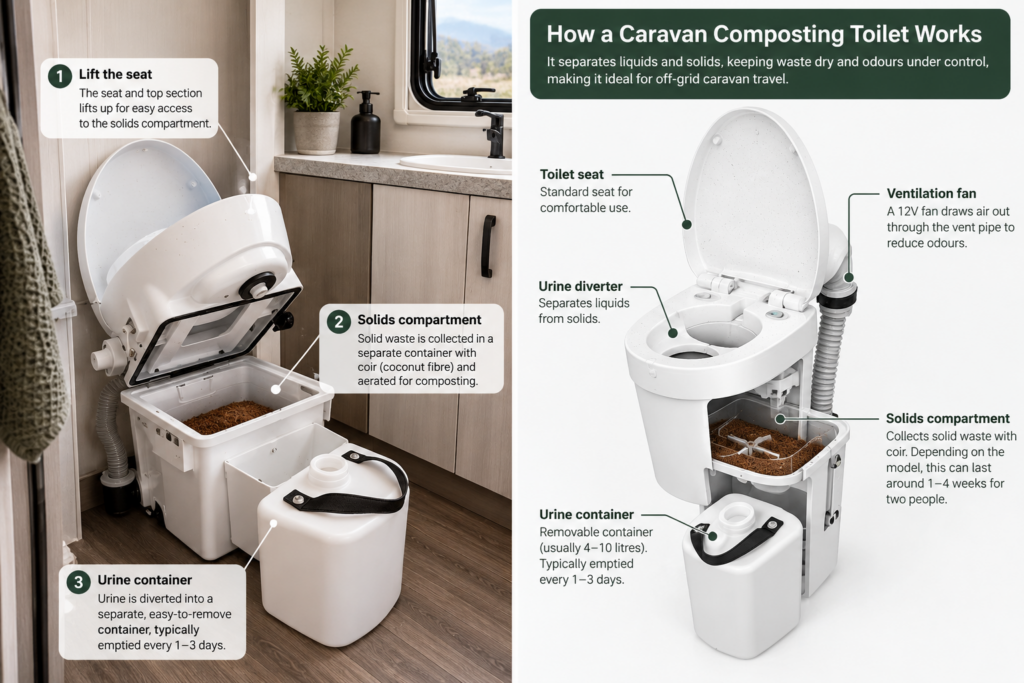
The term usually describes a waterless toilet that separates urine from solid waste. Urine enters a bottle or an approved external collection system. Solids fall into another container, which may contain coconut coir or a removable bag. Some units have an agitator to mix solids with a bulking medium; others simply collect and dry the waste.
Importantly, urine-diverting is not the same as fully composting. In a mobile caravan, waste often remains in the container for too little time to become finished, hygienically treated compost. Think of the toilet as a separation and storage system that can start decomposition, not a machine that automatically produces garden-ready compost.
Why Do Off-Grid Travellers Consider Switching?
Less flushing water. Waterless units preserve freshwater that would otherwise be used to flush a cassette toilet. The amount saved depends on the original toilet and the number of daily uses, so fixed daily savings claims can be misleading.
Different emptying routines. A cassette holds combined waste and flush water, and must be emptied at an appropriate facility when full. Separating systems keep liquids and solids apart, usually extending the interval between solids-emptying tasks. They do not eliminate the need to plan where waste can legally go.
No conventional cassette additives. Many separating models avoid the chemical treatments associated with cassette toilets. However, liners, coir, cleaning supplies and replacement fans can still contribute to running costs.
How Do Composting Toilets Work in a Caravan?
Most designs have a urine diverter at the front of the bowl and a separate solids opening behind it. Users generally sit to ensure the contents reach the intended chamber. Liquids are emptied into an appropriate facility; solids are contained until the manufacturer’s recommended emptying point.
With an active-mixing model, a handle or electric agitator distributes coconut coir through the solids. A ventilation fan moves moist air outside and helps control smells. Bag-based separating models, such as the Separett Tiny, work differently: they do not require mixing or coir. Always follow the manual for the exact model.
Good installations reduce odour, but incorrect separation, full bottles or blocked vents can cause problems.
Composting Toilet Vs Cassette Toilet: The Practical Differences
| Consideration | Cassette Toilet | Waterless Separating Toilet |
| Flushing | Usually uses water | No flush water |
| Waste storage | Liquids and solids together | Separate collection |
| Emptying | Full cassette to an approved point | Liquids regularly; solids vary by model |
| Odour management | Seals and suitable treatments | Separation, cleaning and often ventilation |
| Installation | Existing factory systems are straightforward | Venting, power and fit may need assessment |
| Routine | Familiar for many travellers | New habits and two waste streams |
A cassette suits routes with frequent approved dump points. Waterless systems appeal when water is limited, provided separate disposal suits your route.
What Are the Disadvantages of Composting Toilets?
The biggest surprise for new owners is often how frequently the liquid bottle fills. Separating toilets may delay solids emptying, but urine still needs attention every day or two for some travelling parties. Carrying a full container through a small bathroom is not everyone’s preferred routine.
Other considerations include learning the correct seated position, keeping the ventilation system running, buying model-specific consumables and handling waste that is not yet finished compost. Families should check whether children can comfortably use the diverter. In wet bathrooms, covers, seals and mounting arrangements also matter.
Composting Toilets Available in Australia
Here are the main models available to Australian caravan buyers in 2026.
MODEL 1
- Nature’s Head.
- Best for: Full-time and extended travel.
- Australian distributor: EnviroPro / natureshead.com.au.
The Nature’s Head is arguably the most proven composting toilet in the Australian caravan and marine market. EnviroPro has been selling and supporting it in Australia for over 12 years, and its reputation in the caravanning community is well established.
It uses a coir-based composting medium in the solids chamber, with a manual or spider-handle agitator to turn the compost and speed decomposition. The urine container is separate and easy to remove. The unit operates on 12V and requires a ventilation pipe.
- Dimensions: 450mm wide × 546mm high × 475mm deep.
- Power: 12V DC fan (low draw).
- Capacity: Suitable for 1–2 people.
- Price: Around $1,895 AUD.
MODEL 2
- OGO Origin.
- Best for: Permanent caravan installation, luxury builds.
- Australian distributor: OGO / ogotoilet.com.au.
The OGO Origin is one of the more sophisticated composting toilet options available, with an automatic agitator (no manual turning required), a built-in urine level sensor that alerts you when the container needs emptying, and a 12V ventilation fan. Its compact, modern design suits the aesthetic of higher-spec caravan bathrooms.
The OGO Nomad is the portable version — designed for camper trailers, tent camping, and situations where a permanently installed unit isn’t practical.
- Power: 12V DC.
- Features: Automatic agitator, urine level sensor, removable solid bin.
- Price: Around $2,095 AUD for the Origin.
MODEL 3
- Separett Tiny (2025 model).
- Best for: Compact spaces, camper vans, smaller caravans.
- Australian distributor: Separett / separett.com/au and Campera.
The Separett Tiny (updated 2025 model) is a urine-diverting toilet rather than a true composting unit — it separates liquids from solids and uses a compostable bag liner rather than a coir medium. The bag is sealed and removed when full, which some users find simpler to manage than a composting medium.
The 2025 redesign features a fixed front in the up-position for improved stability, a redesigned urine nozzle, and improved gasket design. It runs on 12V or 110–240V AC and requires a 50mm vent pipe. Winner of the European Product Design Award 2021 for Sustainable Living.
- Power: 12V DC or 110–240V AC.
- Vent pipe: 50mm.
- Urine outlet: 32mm hose to separate container.
- Price: Around $1,700–$1,900 AUD.
MODEL 4
- Cuddy by Compo Closet.
- Best for: Compact installs, flexible venting, retrofits.
- Australian distributor: Compo Closet / compocloset.com.au.
The Cuddy is a newer entrant to the Australian market that has gained traction for its flush-wall mounting design and multiple venting options — it can be installed with external venting or used portably.
It features a manual agitator, a urine diverter, and what the manufacturer describes as the largest drop zone in its class.
- Dimensions: 422mm H × 385mm W × 432mm D.
- Weight: 9.5kg.
- Warranty: 24 months.
- Price: Around $1,795.
How Often Do Different Models Need Emptying?
Manufacturer guidance is more useful than broad claims about how long a composting toilet lasts.
- Nature’s Head: Uses a solids chamber with coir and a manual agitator. Its capacity depends on the number of uses, not a guaranteed number of weeks.
- OGO Origin: Combines an electric agitator, ventilation fan and urine-level indicator. Check the current manual for capacity and operating requirements.
- Separett Tiny: This bag-based urine-diverting toilet requires no mixing medium. Separett states that, with two full-time users, the solids container needs emptying approximately once a week.
- Cuddy by Compo Closet: Uses a compact separating design; the Australian supplier estimates roughly two to three weeks of full-time solids capacity for two people.
Actual intervals change with usage, humidity, toilet paper, ventilation and the number of travellers. Check the precise model variant, because some have an internal urine bottle while others use an external hose.
Can You Install a Composting Toilet in an Existing Caravan?
Often, but it is not automatically a drop-in replacement. Start by measuring the bathroom, including the clearance needed to open the lid and remove both containers. Confirm how a ventilation pipe will reach the outside without interfering with structural components, waterproofing or existing services.
Many installed models also need a suitable 12V supply for a continuous fan, and some use power for an agitator. Check travel restraints and how the previous cassette opening will be finished.
For a new caravan, check manufacturer compatibility. Use a qualified installer for modifications needing electrical work or structural sealing.
Where Can You Dispose of Composting Toilet Waste in Australia?
Do not assume that separated waste can be tipped onto the ground or buried anywhere. Rules and facility requirements differ by state, council, land manager and campsite.
For urine, an appropriate flushing toilet or authorised disposal facility may be suitable, provided the operator permits it. Never empty urine into stormwater drains or near waterways. For solids, follow the product instructions and check whether an approved waste facility accepts securely bagged material or whether an appropriate managed composting system is available. Do not put human waste into ordinary green-waste bins without explicit authorisation.
National-park guidance illustrates why local checks matter. NSW National Parks‘ general camping advice describes specific conditions for burying human waste or carrying it out. Queensland Parks separately directs chemical-toilet users to approved dump points and sets different bush-toileting instructions. Neither is a blanket approval to empty a caravan toilet wherever you stop.
Most importantly, material removed from a caravan toilet may still contain pathogens. It should never be described as ready-to-use compost simply because it looks dry.
What Does a Caravan Composting Toilet Cost?
Upfront prices vary by design and supplier. Australian prices checked in October 2026 include $1,895 for Nature’s Head, $1,795 for Cuddy and $2,095 for OGO Origin. Verify prices and inclusions before budgeting.
Allow separately for professional installation where needed, venting, electrical work, consumables and future replacement parts. Retaining a functioning cassette may cost less. Compare total running costs and convenience, not just purchase prices.
Which Caravan Travellers Benefit Most?
A couple regularly travelling on remote routes may value water savings and longer intervals between handling solids. A family staying mainly in serviced parks might prefer a familiar cassette system with predictable dump-point access. Travellers with limited bathroom space should pay special attention to the footprint and access required by each option.
Before deciding, ask: How many people will use it? What is the longest time between approved disposal facilities? Can everyone manage the emptying routine? Will the fan have reliable power? Those answers matter more than whether a toilet is marketed as an off-grid essential.
A composting toilet can make a caravan more practical for certain off-grid journeys, but it cannot remove the responsibility to store and dispose of waste safely. Learn the difference between systems, check the real capacity and installation requirements, and choose for your travel habits rather than the trend.
For broader planning, explore off-road caravan options and Australian caravan dealers on Luxury Caravans.
Disclaimer: Prices listed are indicative as at October 2026 and may vary by retailer. Always confirm current pricing, specifications, and availability directly with the relevant supplier. Disposal regulations for composting toilet waste vary by state, territory, and land management authority — check local guidelines before travelling to remote or conservation areas.
Frequently Asked Questions
Do Composting Toilets Smell Inside Caravans?
They can have little noticeable odour when correctly installed and maintained, but problems can occur if liquid enters the solids chamber, the ventilation fails or containers are overdue for emptying. Follow the ventilation and cleaning guidance for your model.
Can Toilet Paper Go Into a Composting Toilet?
Often yes, but requirements differ. Some systems accept toilet paper in the solids container, while others encourage a separate bin to preserve capacity. Follow the model’s manual rather than applying one rule to every toilet.
Does a Caravan Composting Toilet Need Electricity?
Many fixed models use a low-power ventilation fan, commonly supplied by a 12V system. Some also power an agitator. There are different portable designs, so check the exact model’s electrical and ventilation specifications.
Are Composting Toilets Worth It for Weekend Trips?
They can be, particularly if conserving water matters, but a functioning cassette toilet remains a sensible choice for short stays with convenient dump-point access. Consider whether the different cleaning and disposal routine improves your own trips.
 Off-Road Caravans
 Touring Caravans
 Family Caravans
 Lightweight Caravans
 Camper Trailers
 Luxury Motorhomes
 Caravan Pods
 Electric Caravans
 Slide-Out Caravans