A full off-road caravan sounds like the obvious choice if you want to explore Australia beyond the highways. But do you actually need one?
For many travellers, the answer is no. If your trips involve sealed highways, well-maintained gravel roads and established bush camps, a semi off-road caravan may provide the capability you need without paying for equipment designed for much more demanding terrain.
The challenge is knowing where one category ends and the other begins. Australian caravan manufacturers use different specifications and descriptions, making it difficult to compare models using their labels alone.
This guide explains the practical differences between semi off-road caravans and full off-road caravans, what to inspect, and how to choose the right option for your travel plans.
What Is the Difference Between Semi Off-Road and Full Off-Road Caravans?
A semi off-road caravan is generally intended for sealed roads and suitable formed unsealed roads, while a full off-road caravan is typically designed for more frequent travel across rougher tracks and sustained corrugations.
However, there is no universal Australian Design Rule classification that certifies either label as a specific level of off-road capability.
Two caravans advertised as full off-road can have very different suspension systems, clearance, chassis construction and intended uses. The same applies to semi off-road models.
Always compare the actual specifications and the manufacturer’s written operating guidance.
Semi Off-Road vs Full Off-Road Caravans: Quick Comparison.
| Feature | Semi Off-Road Caravan | Full Off-Road Caravan |
| Typical Travel. | Highways, formed gravel and maintained dirt roads. | Rougher unsealed routes and remote touring where approved. |
| Chassis. | May feature strengthening or a raised touring chassis. | Often incorporates heavier-duty construction and reinforcement. |
| Suspension. | Upgraded or independent systems may be fitted. | Usually prioritises sustained rough-road performance. |
| Ground Clearance. | Often increased over a conventional touring model. | Typically places greater emphasis on clearance and protection. |
| Coupling. | Standard or articulating coupling, depending on the model. | Articulating off-road couplings are common. |
| Weight. | May be lighter, but not necessarily. | Additional equipment can increase weight. |
| Cost. | Often less expensive at comparable specifications. | Specialist construction may increase the purchase price. |
| Best Suited To. | Mixed highway and maintained-road touring. | Frequent demanding routes within manufacturer limits. |
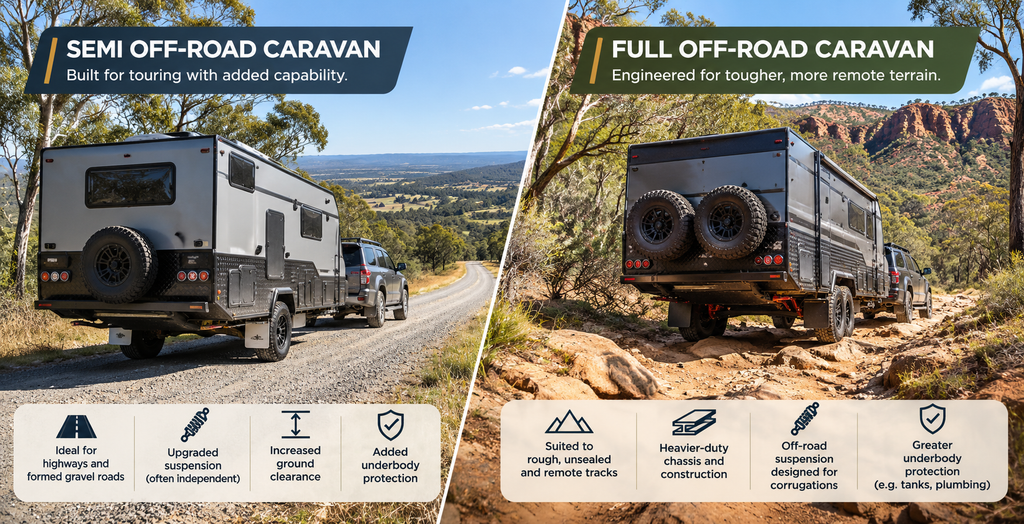
These are typical differences, not guaranteed specifications for every manufacturer.
What Is a Semi Off-Road Caravan?
Semi off-road caravans sit between conventional touring caravans and more specialised off-road models.
They are generally aimed at travellers who spend most of their time on sealed roads but want access to suitable gravel roads, maintained station tracks and established campsites away from major highways.
Depending on the model, a semi off-road caravan may offer increased ground clearance, upgraded suspension, all-terrain tyres, stone protection and reinforced construction.
This makes it worth considering for couples and families who enjoy regional touring but do not regularly attempt difficult four-wheel-drive tracks.
However, semi off-road does not mean suitable for every unsealed road. Deep ruts, prolonged corrugations, washouts, water crossings and rapidly deteriorating surfaces can exceed a model’s intended capability.
What Makes a Full Off-Road Caravan Different?
Full off-road caravans are usually designed with more demanding travel conditions in mind.
Common features include substantial chassis construction, heavy-duty suspension, articulating couplings, protected plumbing and wiring, and increased attention to approach, departure and underbody clearance.
Some models also include substantial solar systems, lithium batteries and water storage for longer periods away from powered campsites.
These features can be useful when rough-road travel is a regular part of your plans. They also introduce potential trade-offs in weight, maintenance and price.
A full off-road label is not permission to tow anywhere. Route conditions, vehicle capability, loading and manufacturer restrictions remain essential considerations.
Which Features Actually Matter When Comparing Caravans?
Rather than choosing by appearance or branding, inspect the components that affect how the caravan performs.
- Chassis and suspension. Ask how the construction and suspension are designed for repeated vibration, uneven surfaces and the caravan’s loaded weight.
- Ground clearance. Check clearance beneath water tanks, plumbing, steps and other vulnerable parts, not just the chassis rails.
- Rear departure angle. A long rear overhang can contact the ground even when the caravan has substantial axle clearance.
- Coupling and tyres. Verify articulation, tyre load ratings, suitable pressures and compatibility with the towing vehicle.
- Dust and stone protection. Inspect seals, stone guards and the protection provided to wiring, tanks and fittings.
- Serviceability. Consider how easily damaged components can be inspected or repaired when travelling away from major towns.
An expensive suspension system alone does not establish the capability of the entire caravan.
Which Caravan Suits the Roads You Actually Travel?
Consider three common Australian travel patterns.
Mostly Highway Touring With Occasional Gravel Roads. If you primarily visit caravan parks, established campgrounds and regional destinations using sealed highways, a touring or appropriately specified semi off-road caravan may be sufficient.
Regular Maintained Dirt Roads and Bush Camps. A capable semi off-road model may suit these trips, provided the manufacturer confirms the intended road conditions. Compare protection, suspension and clearance closely.
Frequent Rough-Road and Remote Touring. If your plans repeatedly involve substantial corrugations, challenging unsealed roads or remote travel, investigate purpose-built full off-road models with documented suitability.
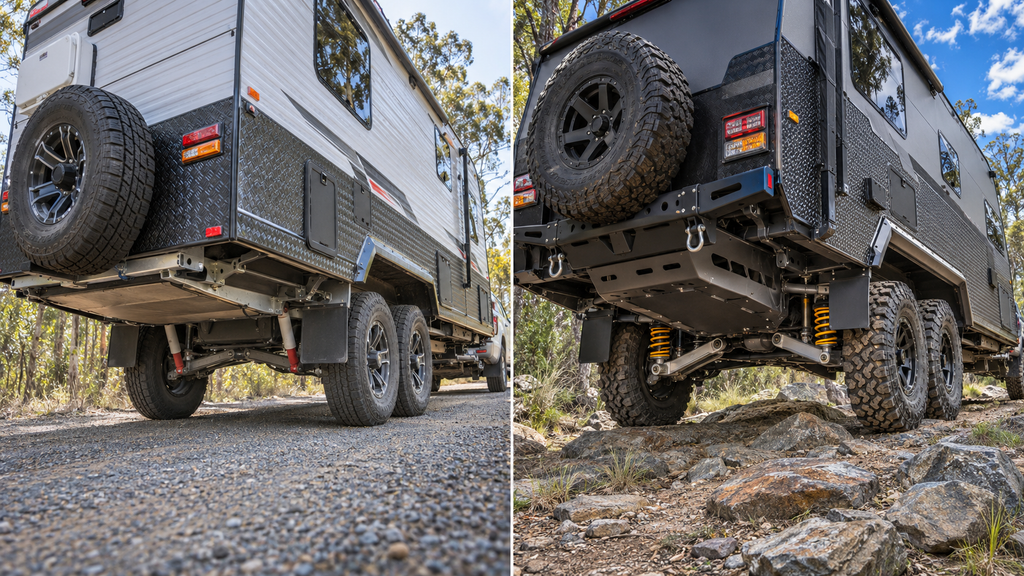
Road conditions vary with weather and maintenance. Even a familiar route can become unsuitable for towing.
Are Full Off-Road Caravans Always Heavier?
No. A compact full off-road caravan can weigh less than a larger semi off-road family model. Weight depends on the complete design, dimensions, equipment and construction.
Check Tare Mass, Aggregate Trailer Mass (ATM), payload, towball download and your towing vehicle’s limits.
For example, a hypothetical caravan with an ATM of 3,000 kg and a Tare Mass of 2,400 kg has a nominal payload of 600 kg. Water, food, luggage and accessories all consume that allowance. Added equipment can reduce the remaining capacity.
Also check vehicle GVM, GCM, axle ratings and towbar limits. A caravan being within the advertised braked towing capacity does not automatically make the loaded combination compliant.
Our Caravan Weights Explained guide covers these calculations in detail.
Are Lightweight Semi Off-Road Caravans Worth Considering?
Lightweight semi off-road caravans can be attractive to travellers who want manageable towing weights without giving up access to suitable unsealed roads.
The important figure is not simply the advertised Tare Mass. Compare the actual configured weight, available payload and construction against your planned trips.
A lighter caravan with insufficient payload or poor protection may be less practical than a slightly heavier, better-specified alternative.
For buyers searching for semi off-road caravans for sale, shortlist models by towing compatibility first, followed by terrain suitability and layout.
Can You Get a Semi Off-Road Caravan With Bunks or a Full Ensuite?
Yes. Some manufacturers offer semi off-road family caravans with double or triple bunks, permanent beds and practical dining areas. Others offer compact couples’ layouts with full ensuites.
However, additional beds, bathroom fittings, water tanks and storage affect the caravan’s dimensions and loaded weight.
For a semi off-road caravan with bunks, check sleeping dimensions, seating capacity and the payload available for everyone’s belongings.
For a semi off-road caravan with a full ensuite, compare shower space, water capacity, waste storage and bathroom access.
Neither feature requires you to choose a full off-road model automatically. The right layout depends on your travel style and the manufacturer’s available specifications.
Does Off-Road Capability Affect Warranty Coverage?
It can, but warranty conditions are specific to each manufacturer and model.
Ask which surfaces, routes and usage conditions the manufacturer considers suitable. Some warranties distinguish graded unsealed roads from severe corrugations, technical four-wheel-drive tracks and deep water crossings.
Request clarification in writing rather than accepting a verbal statement that the caravan can go anywhere.
Importantly, manufacturer’s warranty conditions are separate from applicable Australian Consumer Law guarantees. The ACCC’s caravan guidance explains these rights and cautions against misleading claims about caravan capabilities.
Insurance coverage for remote travel and accidental damage should also be checked separately.
Is a Full Off-Road Caravan Worth the Extra Money?
It can be if you regularly travel in conditions that justify its additional engineering and equipment.
However, paying more does not automatically deliver better value for your particular trips.
Consider the complete ownership cost, including purchase price, towing vehicle suitability, servicing, tyres, suspension maintenance, insurance and potential repairs.
Money spent on capability you rarely use may be better allocated to a layout that suits your family, a more suitable towing vehicle or the equipment required for comfortable touring.
Choose based on the roads you will realistically travel, rather than the most extreme trip you might take someday.
What Should You Ask Before Buying?
Use these questions when comparing actual caravans.
- What roads and terrain is this exact model designed to handle?
- What conditions or routes does the manufacturer advise against?
- What suspension, chassis, coupling and underbody protection are fitted?
- What are the configured Tare Mass, ATM and realistic available payload?
- Can my tow vehicle safely handle the caravan when fully loaded?
- Are the bunk, ensuite and storage arrangements suitable for my family?
- What off-grid water and electrical capacity is included?
- Which maintenance requirements and warranty conditions apply to rough-road use?
- What is included in the quoted price, and what costs extra?
Ask the manufacturer or dealer to provide written specifications and relevant operating guidance before paying a deposit.
For predominantly highway touring with occasional suitable gravel roads, a semi off-road caravan may be all you need. For frequent demanding unsealed routes and remote touring, a properly specified full off-road caravan is generally the better starting point.
Neither label replaces checking the actual construction, towing limits, route suitability and warranty conditions.
Compare Off-Road Caravans and Touring Caravans on Luxury Caravans, then contact manufacturers or dealers directly to confirm specifications, suitability and available configurations.
Editorial Note: This is general buying guidance based on publicly available Australian towing and manufacturer information. It is not a test of any specific caravan. Check the manufacturer’s current instructions, relevant road conditions and applicable towing requirements before travelling.
Can a Semi Off-Road Caravan Go on Dirt Roads?
Yes, some semi off-road caravans are designed for formed gravel and maintained dirt roads. Suitability depends on the specific caravan, road conditions and manufacturer’s guidance. The label alone does not guarantee safe use on every unsealed road.
Is a Semi Off-Road Caravan Good Enough for Travelling Around Australia?
For many highway-based trips with suitable maintained-road access, it can be. However, remote itineraries and demanding tracks may require different capabilities. Review your actual route before deciding.
What Is the Difference Between Off-Road and Off-Grid Caravans?
Off-road describes a caravan’s intended terrain capability, while off-grid describes its ability to operate away from external power, water and campsite facilities. A caravan can have strong off-grid equipment without being designed for demanding off-road conditions.
Are Semi Off-Road Caravans Cheaper Than Full Off-Road Caravans?
They are often less expensive when comparing broadly similar sizes and inclusions. However, prices vary significantly by manufacturer, layout and equipment. Compare detailed quotations rather than assuming one category is always cheaper.
Can You Buy a Lightweight Semi Off-Road Caravan With an Ensuite?
Yes, compact semi off-road models with ensuites are available, although exact layouts and specifications vary. Check shower dimensions, water storage, loaded mass and the tow vehicle’s limits.
Should Families Choose Semi Off-Road or Full Off-Road Caravans?
Families should choose according to their intended roads, towing vehicle, sleeping arrangements and payload requirements. A semi off-road family caravan may suit maintained-road touring, while frequent demanding routes justify investigating suitable full off-road models.
 Off-Road Caravans
 Touring Caravans
 Family Caravans
 Lightweight Caravans
 Camper Trailers
 Luxury Motorhomes
 Caravan Pods
 Electric Caravans
 Slide-Out Caravans