The Five Numbers That Matter
Tare Mass
Tare is the mass of the caravan as it left the manufacturer, before you add anything. Empty water tanks, no food, no clothing, no gear.
The trap is that tare is a starting point, not the weight you will ever actually tow. It is also the number most likely to differ from reality by the time you take delivery. Whether gas bottles, batteries, a second spare wheel or dealer-fitted accessories are included in the stamped tare varies between manufacturers, and anything fitted after the plate was issued adds weight that the plate does not know about. Ask the manufacturer exactly what is and is not included in their tare figure, and treat the answer as build-specific rather than an industry standard.
ATM, Aggregate Trailer Mass
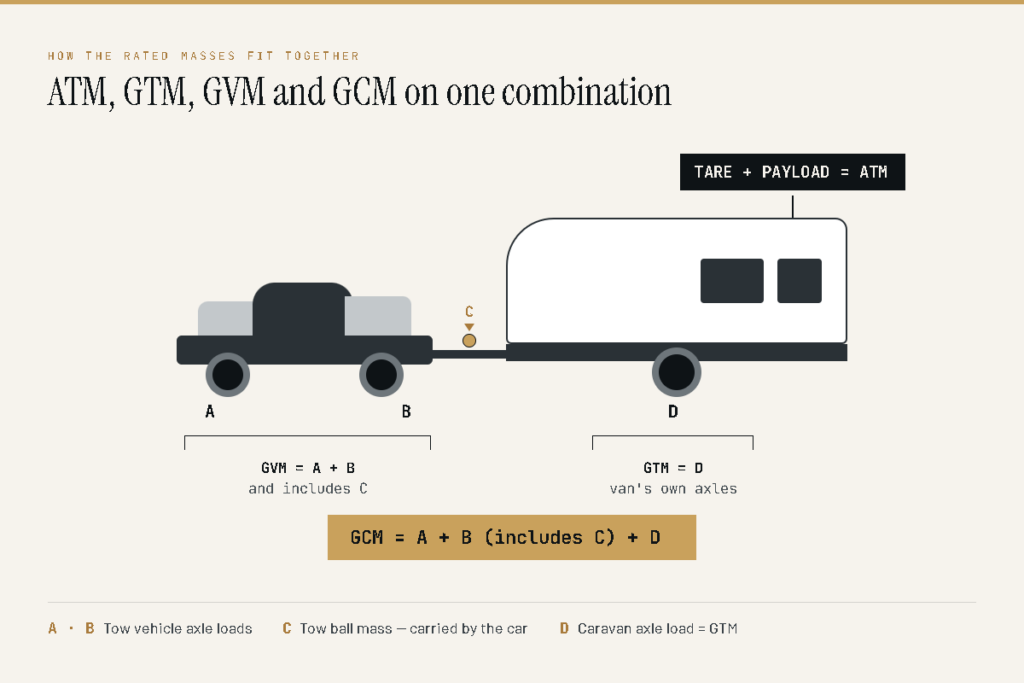
ATM is the maximum legal mass of the fully loaded caravan when it is standing on its own wheels and jockey wheel, unhitched. It includes everything: the van, your gear, water, gas and the mass that will later rest on the tow ball.
This is the single most important figure on the compliance plate, because it is the number your tow vehicle is legally matched against. Your vehicle’s braked towing capacity must be at least equal to the van’s ATM.
GTM, Gross Trailer Mass
GTM is the maximum mass transmitted to the ground through the caravan’s own axles while it is coupled to the tow vehicle. It is always lower than ATM, because once the van is hitched, part of its mass transfers onto the tow ball.
The relationship is straightforward: ATM equals GTM plus tow ball mass. GTM is what your van’s axles, suspension, tyres and brakes are rated to carry, which is why it matters even though ATM is the number enforcement looks at.
GVM, Gross Vehicle Mass
GVM is the maximum loaded mass of the tow vehicle itself, set by the vehicle manufacturer. It covers the vehicle, its occupants, fuel, accessories, everything in the cabin and tray or boot, and the tow ball mass from the caravan.
That last inclusion is what catches people out. Tow ball mass is carried by the car, not the van, and it comes straight out of the car’s available payload.
GCM, Gross Combination Mass
GCM is the maximum combined mass of the loaded tow vehicle and the loaded caravan together, set by the vehicle manufacturer.
It is not simply GVM plus towing capacity. On a great many vehicles those two figures added together exceed the rated GCM, which means you cannot legally run a fully loaded vehicle and a fully loaded van at the same time even though each is individually within its own limit. Check the GCM in your vehicle handbook before you check anything else.
Quick Reference
| Term | What it measures | Whose number is it | Where to find it |
|---|---|---|---|
| Tare | Caravan mass as built, empty | Caravan manufacturer | Caravan compliance plate |
| ATM | Maximum loaded caravan mass, unhitched | Caravan manufacturer | Caravan compliance plate |
| GTM | Maximum mass on the caravan’s axles, hitched | Caravan manufacturer | Caravan compliance plate |
| Tow ball mass | Downward mass on the coupling | Measured, within van and vehicle limits | Ball scale or weighbridge |
| Payload | What you can legally add to the van | Calculated: ATM minus tare | Not stamped, you work it out |
| GVM | Maximum loaded tow vehicle mass | Vehicle manufacturer | Vehicle placard and handbook |
| GCM | Maximum combined loaded mass | Vehicle manufacturer | Vehicle handbook |
Payload: The Number Nobody Stamps on the Plate
Payload is the mass you are allowed to add to the caravan, and it is the only figure in this article you have to calculate yourself.
Payload equals ATM minus tare. If the plate shows an ATM of 3,000 kg and a tare of 2,400 kg, you have 600 kg to work with.
Two vans with an identical tare can offer very different payloads, because payload depends on the gap between tare and ATM rather than on either number alone. A light van with a low ATM can leave you with less usable capacity than a heavier van with a generous one. When you are comparing builds, the gap is the number to compare.
Everything you add consumes payload, and water consumes it faster than anything else. Every litre of fresh water is one kilogram. A van carrying 180 litres is carrying 180 kg the moment the tanks are full, before a single item of clothing goes in.
A Worked Example
The figures below are illustrative only. They are chosen to show the method, not to represent any particular van or vehicle. Use the numbers on your own compliance plate and vehicle placard.
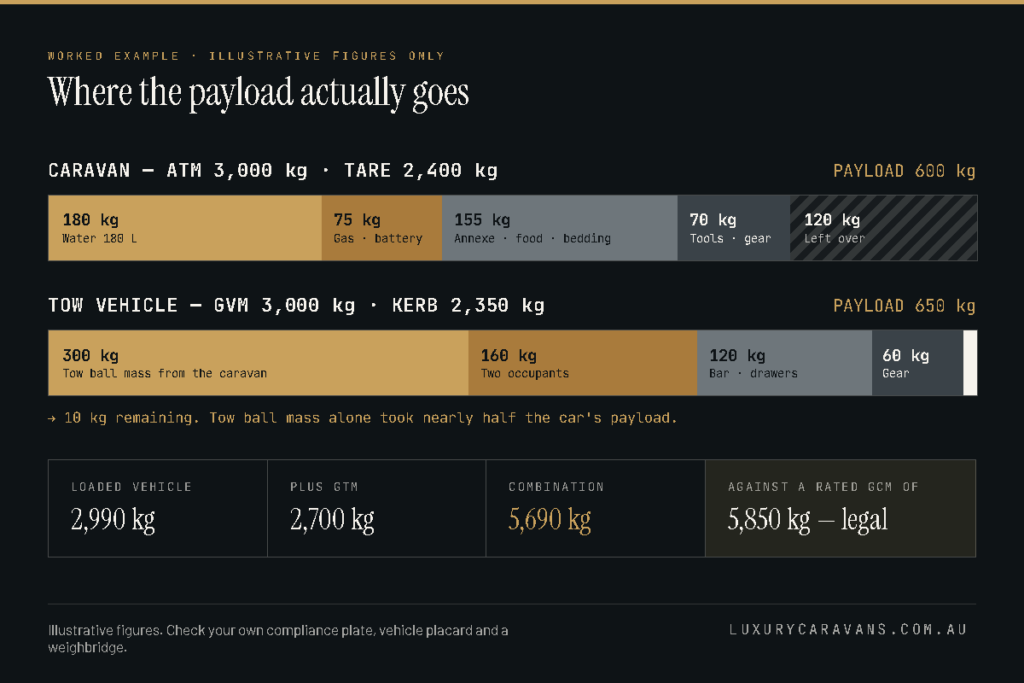
Start with the caravan. The compliance plate shows an ATM of 3,000 kg and a tare of 2,400 kg, so payload is 600 kg. Tow ball mass is measured at 300 kg, which makes GTM 2,700 kg.
Now load it:
| Item | Mass |
|---|---|
| Fresh water, 180 litres | 180 kg |
| Two full 9 kg gas bottles, including bottle mass | 40 kg |
| Battery and inverter upgrade fitted after delivery | 35 kg |
| Annexe and outdoor matting | 30 kg |
| Food, crockery and kitchen gear | 40 kg |
| Clothing and bedding for two | 60 kg |
| Tools and recovery gear | 40 kg |
| Outdoor furniture | 25 kg |
| Generator and fuel | 30 kg |
| Total | 480 kg |
That leaves 120 kg of the 600 kg payload. Comfortable, until you notice that nothing has been packed in the car yet.
Now the tow vehicle. GVM is 3,000 kg and the vehicle weighs 2,350 kg as it sits, so vehicle payload is 650 kg.
| Item | Mass |
|---|---|
| Two occupants | 160 kg |
| Tow ball mass from the caravan | 300 kg |
| Bull bar, drawers and second battery | 120 kg |
| Gear carried in the vehicle | 60 kg |
| Total | 640 kg |
Ten kilograms remaining. The caravan had headroom and the car did not, which is the outcome far more often than buyers expect. Tow ball mass alone consumed nearly half the vehicle’s payload.
Finally, check GCM. The loaded vehicle at 2,990 kg plus a GTM of 2,700 kg gives a combination of 5,690 kg. If the vehicle’s rated GCM is 5,850 kg, this combination is legal. If it were 5,500 kg, it would not be, even though every other individual figure checks out.
How to Read Your Compliance Plate
Every caravan sold in Australia carries a compliance or identification plate, usually near the entry door or on the drawbar. It carries the manufacturer, the VIN, the date of manufacture, and the rated masses.
- Find the plate and photograph it. You will want it on your phone at weighbridges and when talking to insurers.
- Read ATM and GTM directly. The difference between them is the tow ball mass the manufacturer designed for.
- Read tare, then ask what it includes. Accessories fitted after the plate was issued are not reflected in it.
- Calculate payload as ATM minus tare, and write it down.
- If the plate is missing or unreadable, contact the manufacturer or a certified caravan workshop. Do not guess.
Plate figures are ratings, not measurements of your van as it stands today. They tell you the limits. Only a weighbridge tells you where you actually sit against them.
How to Weigh Your Van Properly
A public weighbridge is the only way to know your real numbers. Council waste facilities, transport depots and some service centres offer them, and the cost is minor against the cost of being wrong.
- Weigh the van loaded the way you actually travel, with water in the tanks and gear packed.
- Weigh the van uncoupled on its own wheels to get ATM.
- Weigh the van again coupled, with only the van’s axles on the platform, to get GTM. The difference is your tow ball mass.
- Weigh the loaded tow vehicle separately to check it against GVM.
- Weigh the whole combination to check it against GCM.
Do this once, properly, and you will know for the life of the van. Re-check after any significant accessory fitment.
Five Ways Buyers End Up Overweight
- Treating tare as the towing weight. Tare is the empty factory figure. Nobody tows a van at tare.
- Forgetting water. Full tanks can consume a third or more of a modest payload before anything else is loaded.
- Ignoring accessories fitted after delivery. Solar, batteries, a second spare, drawers and bull bars all add mass that the compliance plate never saw.
- Assuming tow ball mass belongs to the van. It is carried by the car and counts against the car’s GVM.
- Assuming towing capacity and GCM are compatible. Add a vehicle’s GVM to its maximum braked towing capacity and the total very often exceeds its rated GCM.
Is Paying for More Payload Worth It?
Once buyers understand payload, the next question is usually whether to pay for more of it. There is a genuine trade-off here and it is worth setting out honestly.
The Case for a Higher ATM
- You can carry full water tanks, which matters on Australian trips where the gap between reliable refill points can run to hundreds of kilometres.
- Accessories fitted later, such as a lithium battery and inverter upgrade or additional solar, do not push you over.
- You are not repacking and rationing before every trip.
- Buyers researching an off-grid capable build need the headroom, because off-grid capacity is mostly water, batteries and storage, all of which are mass.
The Case Against
- A higher ATM narrows your tow vehicle options, sometimes sharply, and a new vehicle costs more than the payload is worth.
- Over 3,500 kg ATM you move into territory where licence requirements can change depending on your state or territory. Check with your road authority before assuming your current licence covers it.
- Heavier vans use more fuel and are less forgiving to reverse, park and manoeuvre.
- Higher rated chassis, axles and suspension add purchase cost whether or not you use the capacity.
The Alternatives
- Travel with partly filled tanks and refill on arrival. This is the single most effective way to free up payload without buying anything.
- Choose a build with a better tare-to-ATM gap rather than a higher ATM outright. Two vans at the same ATM can offer very different usable payload.
- Move mass to the tow vehicle where the vehicle has the capacity for it, remembering that tow ball mass is already competing for the same allowance.
- Look at a lighter van. Couples in particular often find a smaller, well-specified build solves the weight problem entirely rather than managing it.
- An ATM upgrade on an existing van, where the running gear is rated for it. This is an engineering matter, not a paperwork change, and it can affect resale, so it is worth reading how specification decisions affect resale value first.
What This Means When You Are Shopping
Once you understand the five numbers, the questions to ask a manufacturer get much sharper. Ask what is and is not included in the stamped tare. Ask what the payload is on the specific build you are looking at, not the model in general. Ask what the tare becomes once the options you want are fitted. Ask whether an ATM upgrade is available and what it requires, because upgrading is an engineering matter involving chassis, axles, suspension, brakes and tyres, not a paperwork change.
Those questions are best asked directly. You can browse premium caravan manufacturers and dealers and contact them by phone, email or WhatsApp to ask about tare, payload and available ATM ratings on a specific build before you visit a showroom.
Frequently Asked Questions
What Is the Difference Between ATM and GTM?
ATM is the maximum mass of the loaded caravan standing on its own wheels, unhitched. GTM is the maximum mass carried on the caravan’s axles while it is coupled to the tow vehicle. The difference between them is the tow ball mass, which transfers to the car when you hitch up.
Does Tare Weight Include a Full Water Tank?
No. Tare is measured with empty tanks. A full 180 litre tank adds 180 kg to your loaded mass and comes entirely out of payload.
How Do I Calculate Caravan Payload?
Payload equals ATM minus tare, both of which are on the compliance plate. If accessories have been fitted since the plate was issued, your real available payload is lower than that calculation suggests.
Does Tow Ball Mass Count Against the Caravan or the Car?
The car. Tow ball mass is a downward force on the coupling and it counts against the tow vehicle’s GVM and its rated tow ball capacity. It is not part of GTM.
What Happens if My Caravan Is Over Its ATM?
You may be operating outside the caravan’s legal mass limit, which can attract penalties depending on the applicable state or territory requirements and may complicate an insurance claim. It can also increase braking distances and affect vehicle stability. If you suspect you are over, weigh the van before your next trip.
Can I Increase My Caravan’s ATM?
Sometimes, but only where the chassis, axles, suspension, brakes and tyres are rated for the higher mass. An ATM upgrade requires engineering certification and a new compliance plate. Speak to a certified caravan workshop before assuming it is possible on your van.
Where Do I Find My Caravan’s Weight Figures?
On the compliance plate, usually near the entry door or on the drawbar, and in the owner’s manual. Your tow vehicle’s GVM and GCM are on the vehicle placard and in the vehicle handbook.
Before You Tow
Know your five numbers, weigh the combination loaded, and treat the compliance plate and your vehicle handbook as the authority over anything you read online, including this article.
Two things are specifically Australian about this. First, towing rules, licence classes and enforcement sit with your state or territory road authority rather than with a single national regulator, and the requirements are not identical across borders. If you are travelling interstate, the rules that apply are those of the jurisdiction you are in at the time. Check with the road authority in each state you plan to travel through, and with the National Heavy Vehicle Regulator where heavier combinations are involved.
Second, distance changes the maths. On long remote stretches the practical advice to travel with half-full tanks stops being practical, because the next reliable refill point may be a long way off. Australian touring loads water more often and for longer than touring in denser countries does, which is why payload headroom tends to matter more here than the brochure figures suggest. Public weighbridges are widely available at council waste facilities, transport depots and some service centres in most regions, so weighing loaded is realistic for almost everyone.
If you are still deciding on a van, payload deserves as much weight in the decision as layout does. It is the number that determines whether the caravan fits how you actually travel. Our guide to how to choose a luxury caravan covers the other factors worth weighing alongside it.
 Off-Road Caravans
 Touring Caravans
 Family Caravans
 Lightweight Caravans
 Camper Trailers
 Luxury Motorhomes
 Caravan Pods
 Electric Caravans
 Slide-Out Caravans