The caravan versus motorhome question comes up constantly among buyers researching their next travel setup, and it’s one of the more genuinely open decisions in the entire buying process. Both offer luxury, comfort, and the freedom to travel Australia on your own terms, but they suit different habits, budgets, and priorities in ways that aren’t always obvious from a showroom visit.
This guide compares luxury caravans and motorhomes directly across the factors that matter most, so you can make the decision based on how you actually plan to travel. If you land on a caravan, our ultimate luxury caravan buying checklist is the natural next step.
Flexibility at Your Destination
This is one of the biggest practical differences between the two.
- With a caravan, you can unhitch the tow vehicle and use it independently to explore once set up at a site.
- With a motorhome, the entire vehicle is your accommodation, meaning every trip to the shops or a lookout involves packing up or towing a separate small vehicle.
- Buyers who value flexibility once parked generally lean toward caravans for this reason alone.
Towing vs Driving
- Caravans require a suitable tow vehicle and towing experience, and buyers need to confirm towing capacity carefully, a topic covered in our buying checklist.
- Motorhomes are driven directly, which some buyers find simpler, though manoeuvring a larger motorhome in tight spaces has its own learning curve.
- Reversing a caravan is often cited as the biggest hurdle for new caravan owners, while motorhome owners face different challenges around vehicle length and height clearance.
Living Space and Layout
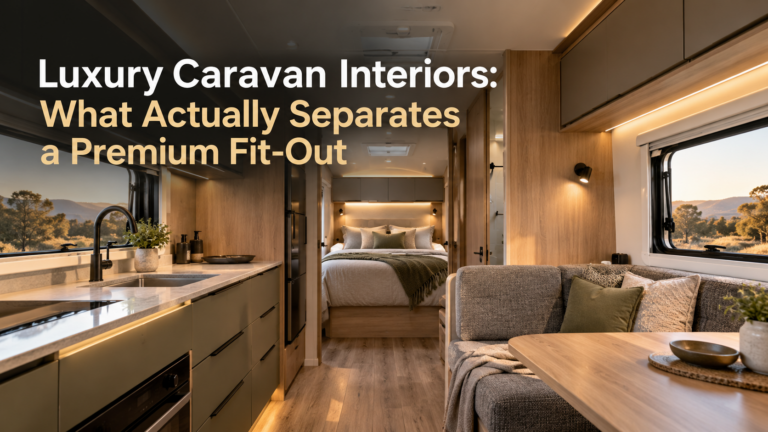
- Caravans generally offer more living space for a given price point, since the tow vehicle isn’t part of the living area cost.
- Motorhomes integrate cab and living space, which can feel more connected but often means less overall room for the same budget.
- Floor plan considerations, covered in our guide on luxury caravan floor plans, apply differently in motorhomes given the fixed cab and drivetrain layout.
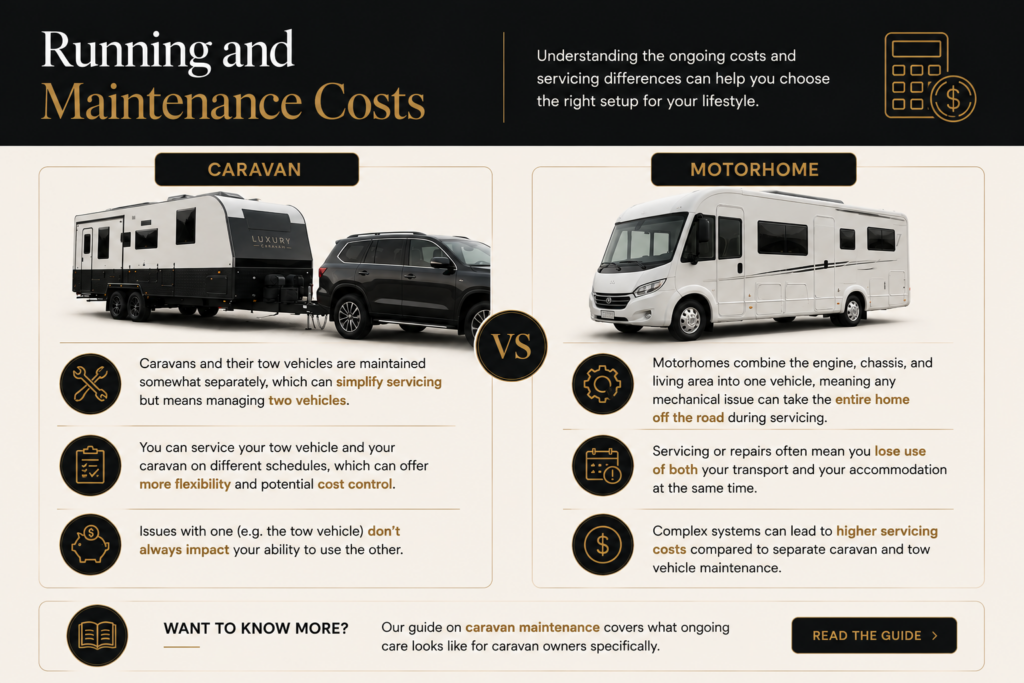
Running and Maintenance Costs
- Caravans and their tow vehicles are maintained somewhat separately, which can simplify servicing but means managing two vehicles.
- Motorhomes combine the engine, chassis, and living area into one vehicle, meaning any mechanical issue can take the entire home off the road during servicing.
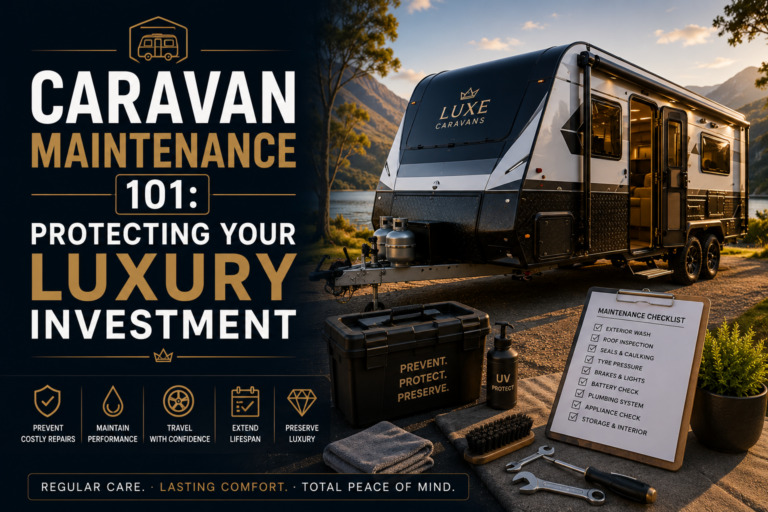
- Our guide on caravan maintenance covers what ongoing care looks like for caravan owners specifically.
Off-Grid and Power Considerations
Both caravans and motorhomes can be set up for genuine off-grid travel, and the same power principles apply in either case.
- Solar, lithium battery, and inverter sizing matter equally, covered in our guides on solar power and lithium batteries.
- Motorhomes sometimes have an advantage running larger alternators off the vehicle engine for charging while driving.
- Caravans benefit from DC-DC charging from the tow vehicle, achieving a similar result.
Resale and Depreciation
- Depreciation patterns differ between caravans and motorhomes, partly due to the added mechanical complexity of a motorhome’s engine and chassis.
- Our guide on luxury caravan costs and resale value covers what luxury caravan buyers should expect specifically over time.
- Motorhomes generally depreciate at a rate closer to other vehicles with engines, given the added mechanical wear considerations.
Which One Actually Suits You?
- Choose a caravan if flexibility at your destination matters, you’re comfortable towing, and you want more living space for your budget.
- Choose a motorhome if you prefer a single vehicle to manage, don’t mind towing a small car if flexibility is needed, and value the simplicity of driving rather than towing.
There’s no universally correct answer in the caravan versus motorhome debate, only the option that matches your travel habits, comfort with towing or driving, and how you want your days to unfold once you reach a destination. Caravans tend to suit buyers who value flexibility and living space, while motorhomes suit those who prefer a single, self-contained vehicle. Take the time to test drive or tow both before deciding, since the difference is felt far more on the road than in a brochure.
If a caravan is the right fit, browse current stock across our dealer directory, or work through our ultimate buying checklist before making your final decision.
Frequently Asked Questions
Is a motorhome easier to drive than towing a caravan?
Many buyers find motorhomes more straightforward to drive since there’s no towing or reversing a trailer involved, though larger motorhomes bring their own challenges around length and height.
Which option offers better value for the same budget?
Caravans generally offer more living space for a comparable price, since the cost of a separate tow vehicle isn’t built into the living area itself.
Can both caravans and motorhomes be set up for off-grid travel?
Yes, both can be equipped with solar, lithium batteries, and appropriately sized inverters to support genuine off-grid touring.
Do motorhomes depreciate faster than caravans?
Generally yes, since motorhomes include an engine and chassis that wear and age similarly to any other vehicle, in addition to the living area itself.
Which is better for someone new to towing or driving large vehicles?
It depends on the individual, but many first-time buyers find a smaller, well-equipped caravan an easier entry point than learning to manoeuvre a full-size motorhome.
 Off-Road Caravans
 Touring Caravans
 Family Caravans
 Lightweight Caravans
 Camper Trailers
 Luxury Motorhomes
 Caravan Pods
 Electric Caravans
 Slide-Out Caravans