Camper trailer types in Australia include soft-floor, hard-floor, hybrid and pop-up designs, with forward-fold, rear-fold and double-fold layouts commonly sitting within the hard-floor category. Choosing between them comes down to how the camper opens, the usable living space, setup effort, your vehicle’s towing limits and the conditions you plan to travel through.
For Australian buyers, the confusing part is that these names overlap. A forward-fold camper trailer is usually a hard-floor model, while a hybrid combines camper trailer features with a more enclosed, caravan-style body.
This guide explains how the different designs work, compares their advantages and limitations, and helps you decide which camper trailer best suits your travel plans.
What Are the Main Camper Trailer Types in Australia?
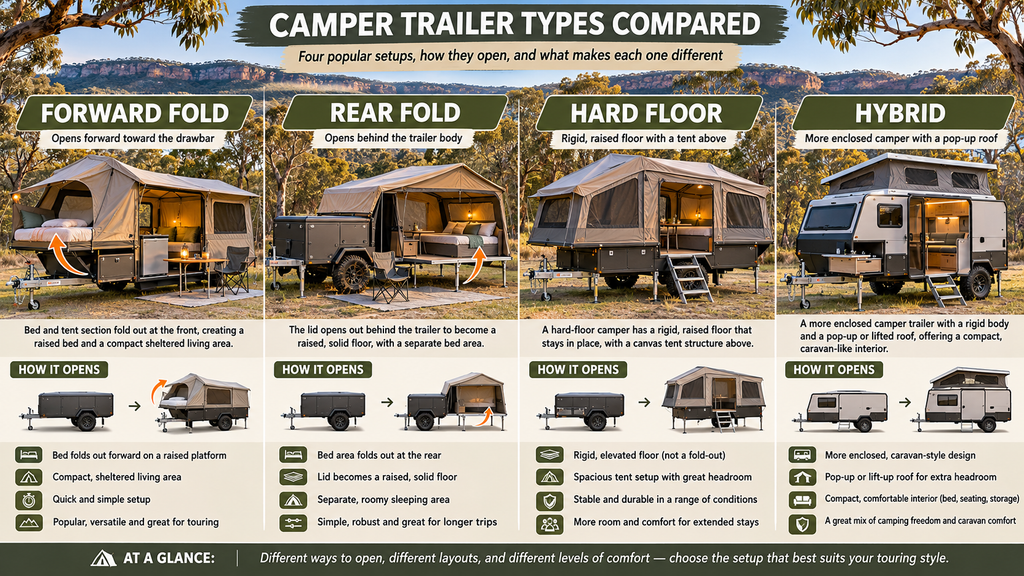
The main types of camper trailer differ in their floor construction, folding mechanism and amount of enclosed living space.
A soft-floor camper generally unfolds into a tent-style structure with a flexible floor. A hard-floor camper uses a rigid floor, often raised above the ground. Forward-fold, rear-fold and double-fold layouts describe how hard-floor sections open, rather than entirely separate construction categories.
Hybrid camper trailers typically have a more rigid, enclosed body, sometimes with an expanding roof or sleeping section. Pop-up and wind-up designs use a lifting roof or other mechanism to create additional space at camp.
Understanding these differences helps buyers compare the features that affect everyday use rather than relying on the category name alone.
Camper Trailer Types Comparison
| Camper Trailer Type | How It Opens | Main Advantage | Main Consideration |
| Soft-Floor | A canvas tent unfolds with a flexible floor resting on the ground. | Generous living space, often at a lower purchase price. | More ground preparation and canvas setup. |
| Hard-Floor | A rigid panel or fixed floor forms the main living area. | Raised, solid flooring and easier cleaning. | Size, weight and setup vary by layout. |
| Forward-Fold | A hinged section opens towards the drawbar. | Compact campsite footprint and often built-in seating. | Limited internal floor space in some designs. |
| Rear-Fold | A hinged section opens behind the trailer. | Raised living floor and often useful under-bed storage. | Additional rear clearance is required. |
| Double-Fold | Sections extend from both ends. | Extra sleeping capacity and living space. | Larger deployed footprint and potentially greater weight. |
| Hybrid | A mostly rigid cabin with optional expanding sections. | More enclosed accommodation and integrated amenities. | Often heavier and more expensive than basic campers. |
| Pop-Up/Wind-Up | The roof lifts, sometimes with additional expanding beds. | Lower travel profile with extra standing room at camp. | Lifting mechanisms and seals need maintenance. |
Important: These are overlapping design descriptions. Forward-fold, rear-fold and double-fold campers are commonly hard-floor models, while the terms hybrid and pop-up are used differently by individual manufacturers.
The best camper trailer is not necessarily the one with the most features. It is the one that fits your towing vehicle, sleeping requirements and camping routine.
How Does a Forward Fold Camper Trailer Open?
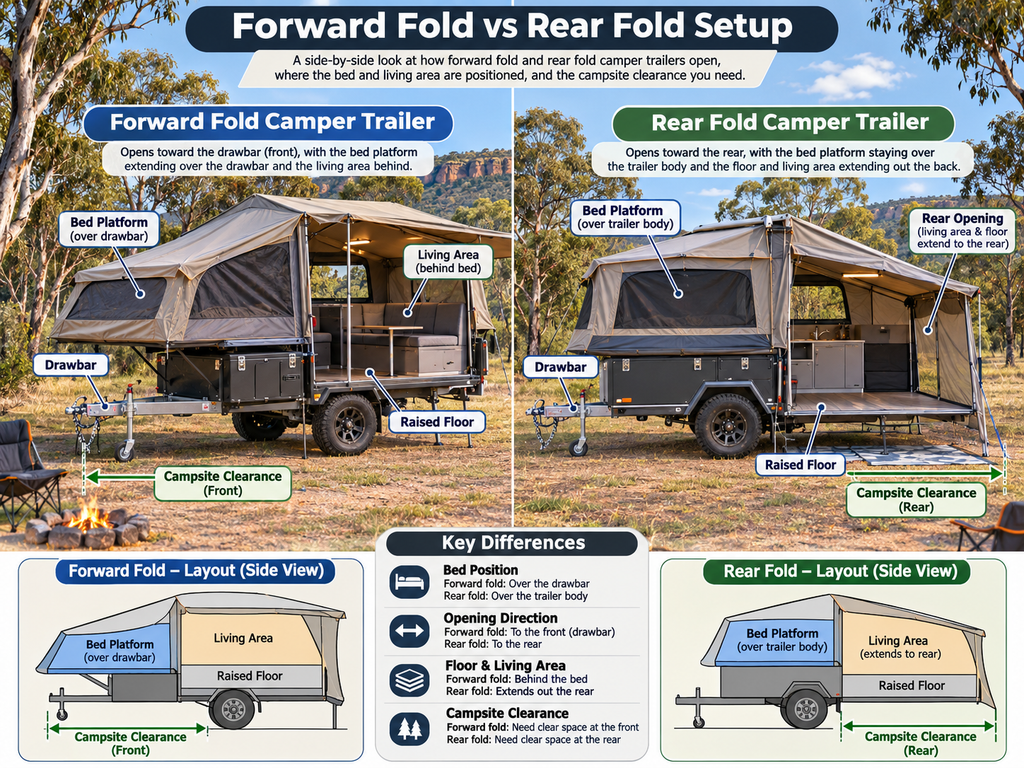
A forward fold camper trailer opens towards the drawbar, typically moving a hinged roof or bed section forward to create the sleeping area.
In many designs, the main living floor remains within the trailer body. This arrangement allows manufacturers to include a dinette, lounge or additional seating without needing a large floor section behind the camper.
Forward folds are popular with couples and small families who want a relatively compact setup and more structured internal seating.
Advantages of Forward Fold Camper Trailers
- Compact Campsite Footprint: The folding section opens towards the front, which can reduce the space required behind the trailer.
- Built-In Seating: Many models include a dinette or lounge that may convert into additional sleeping space.
- Practical Living Layout: A fixed central floor can provide convenient access to seating and storage.
- Convenient Setup: Some designs use integrated mechanisms that reduce the amount of loose canvas and pole assembly.
Limitations of Forward Fold Camper Trailers
- Variable Storage Space: Internal storage and accessibility depend on the bed platform, seating and compartment layout.
- Towing Weight: A compact forward-fold camper is not necessarily lightweight.
- Front Clearance: Buyers need to check drawbar access, folding clearance and whether the manufacturer permits setup while hitched.
A forward fold is worth considering if you regularly change campsites, value built-in seating and prefer a compact living arrangement.
What Is a Rear Fold Camper Trailer?
A rear fold camper trailer opens towards the back of the trailer, usually lowering a rigid panel to create an elevated living floor.
The main bed commonly remains within the trailer body, with storage often positioned underneath it. When opened, the rear section provides a separate floor area that can accommodate additional canvas living space.
This layout appeals to travellers who prefer a straightforward sleeping arrangement and a hard-floor living area raised above the campsite surface.
Advantages of Rear Fold Camper Trailers
- Raised Living Floor: The rigid floor keeps the primary indoor living area above the ground.
- Fixed Sleeping Area: Many designs allow the main mattress to remain in position during setup and pack-down.
- Under-Bed Storage: Some models provide useful storage compartments below the sleeping platform.
- Practical Layout: The separation between the sleeping platform and deployed floor can suit couples or small families.
Limitations of Rear Fold Camper Trailers
- Rear Campsite Clearance: The camper requires enough room behind the trailer for the floor to unfold.
- Canvas Maintenance: Folding canvas, seals and zips need regular inspection and proper drying.
- Setup Differences: The effort required depends on the folding mechanism, stabilisers, awning and additional accessories.
Rear folds can suit buyers who want a raised living floor, a permanent sleeping platform and straightforward access to their camping equipment.
What Does Hard Floor Mean in a Camper Trailer?
A hard floor camper trailer has a rigid living floor rather than a flexible tent floor resting directly on the ground.
In many rear-fold and double-fold designs, the trailer’s hard cover folds down to become part of the floor. Forward-fold campers commonly retain a fixed central floor while the sleeping section opens forward.
This means hard floor describes the camper’s construction, not necessarily the direction in which it opens.
Compared with a traditional soft-floor camper, a hard-floor design can make it easier to keep the main living area clean and reduce contact with wet or uneven ground.
However, a raised floor does not make a camper waterproof, and the amount of weather protection still depends on the canvas, seals, drainage and overall build quality.
Is a Hard Floor Camper Trailer Better Than a Soft Floor?
Hard-floor campers may be more convenient for travellers who frequently move campsites or prefer a solid raised floor.
Soft-floor models can offer greater living space for the purchase price, making them attractive to families and campers who stay in one location for several days.
Neither construction type is automatically lighter, more durable or better for off-road use. Those qualities must be assessed against individual model specifications.
How Is a Hybrid Camper Trailer Different?
A hybrid camper trailer combines some of the compactness and outdoor living features of a camper trailer with a more enclosed, caravan-style body.
Unlike traditional folding campers that rely heavily on canvas, hybrids typically provide rigid walls around much of the sleeping or living accommodation.
Some models also include an internal kitchen, toilet, shower, dinette or fixed bed, although these features are not standard across every hybrid.
The amount of canvas varies. Some hybrids have an expanding roof or sleeping section, while others have a largely fixed body.
Advantages of Hybrid Camper Trailers
- More Enclosed Accommodation: Rigid walls can improve privacy and reduce exposure to wind and rain.
- Integrated Facilities: Depending on the model, kitchens, storage, bathrooms and electrical systems may be built in.
- Reduced Canvas Setup: Some designs require fewer folding steps before the sleeping area can be used.
- Extended Touring Comfort: Enclosed sleeping and living areas can be useful during longer trips or changing weather conditions.
Limitations of Hybrid Camper Trailers
- Higher Towing Weight: Many hybrids carry more structure and equipment than basic folding campers.
- Higher Purchase Cost: Built-in amenities and complex construction can increase the initial price.
- Reduced Flexibility on Tight Tracks: Larger bodies may limit access to narrow campsites and some touring routes.
A hybrid is worth considering if you prefer enclosed sleeping accommodation and want additional comfort without necessarily moving to a full-size caravan.
However, a hybrid camper trailer is not automatically an off-road camper trailer. Its suitability for unsealed roads and rough tracks depends on the individual model, suspension, ground clearance, chassis and manufacturer’s guidance.
What Other Camper Trailer Types Are Available?
Forward-fold, rear-fold, hard-floor and hybrid models are useful starting points, but Australian buyers will also encounter several related designs.
Soft-Floor Camper Trailers
A soft-floor camper trailer unfolds into a tent-style living area with canvas walls and a flexible floor resting on the ground.
These designs can provide generous space for families and may be more affordable than a similarly equipped hard-floor or hybrid model.
The trade-off is additional ground preparation, canvas setup and cleaning, particularly after wet-weather camping.
Double-Fold Camper Trailers
A double-fold camper trailer opens at both ends, commonly providing additional sleeping areas around a central living space.
Some models are designed for larger families and can sleep several people without relying entirely on convertible lounge beds.
Buyers should consider the complete campsite footprint, loaded weight and the effort required to set up both sections.
Pop-Up and Wind-Up Camper Trailers
A pop-up camper trailer or wind-up design uses a lifting roof to increase standing height while maintaining a lower profile during travel.
Depending on the design, it may also have expanding bed sections or canvas walls.
Some manufacturers market these models as camper trailers, while others classify them as pop-top or wind-up caravans. Always compare the actual construction rather than the marketing category alone.
Side-Fold Camper Trailers
Side-fold campers open from the side rather than the front or rear. Depending on the design, the expanding section may use a soft floor, a hard floor or an elevated sleeping platform.
This layout can be useful where the trailer’s rear is reserved for a kitchen or other equipment, although it requires sufficient clearance beside the camper.
Which Camper Trailer Type Suits Your Travel Style?
The right camper trailer depends on how you travel and what you need once you arrive.
For Couples Moving Camps Frequently.
A compact rear-fold, forward-fold or hybrid camper may suit travellers who regularly stay one or two nights before moving on. Compare the complete setup process, including the awning and stabilisers, rather than relying on advertised setup times.
For Families Needing More Sleeping Space.
Double-fold and spacious soft-floor campers are worth considering because they can provide additional sleeping areas. Check the actual number of beds, usable storage and loaded towing weight.
For Travellers Using Smaller Campsites.
Forward-fold models can offer a relatively compact deployed footprint. However, the total space needed must include the drawbar, awning, access steps and other accessories.
For Travellers Wanting Enclosed Comfort.
Hybrid campers may be a better starting point when you want rigid walls, integrated amenities and less canvas exposure.
For Budget-Conscious Buyers.
Soft-floor camper trailers can offer generous space at a lower initial cost. Check the condition of canvas, flooring and folding mechanisms when assessing used models.
There is no single camper trailer type that suits every Australian traveller. Compare individual models against your actual touring needs.
What Should You Check Before Choosing a Camper Trailer?
1. Towing Weight and Vehicle Limits
A camper trailer’s size does not reliably indicate its weight.
For example, Cub Campers’ published range lists the 2026 Frontier forward-fold camper at 1,283 kg tare, while the 2027 Explorer rear-fold camper is listed at 827 kg tare.
These are individual model specifications, not weight averages for each camper type. Optional equipment and actual build specifications may change the figures.
Before choosing a camper, check:
- Tare Mass: The trailer’s specified unladen mass.
- ATM (Aggregate Trailer Mass): The manufacturer’s maximum permitted loaded trailer mass.
- GTM (Gross Trailer Mass): The maximum mass supported by the trailer wheels when coupled to the tow vehicle.
- Tow-Ball Download: The load transferred through the coupling to the tow vehicle.
- Payload: The available weight allowance for water, gas, food, luggage and additional equipment.
Also check your vehicle’s towing capacity, GVM, GCM, towbar and tow-ball ratings. Being under the advertised braked towing limit does not automatically mean the entire combination is within every applicable limit.
For a detailed explanation, read our Caravan Weights Explained: ATM, GTM, Tare and Payload guide.
2. Braking Requirements
Australian trailer braking requirements are based on GTM, not ATM.
The Australian Government’s Vehicle Standards Bulletin 1, Revision 6, updated in August 2026 explains the relevant trailer construction requirements.
Under its braking guidance:
- Trailers with a GTM of 750 kg or less are not required to have brakes.
- Trailers exceeding 750 kg GTM require an efficient service braking system.
- Trailers exceeding 2,000 kg GTM require brakes operating on all wheels and an emergency breakaway braking system.
Check the applicable standards, your vehicle manufacturer’s instructions and state or territory requirements before towing.
3. Setup Time and Campsite Clearance
Ask the dealer to demonstrate a complete setup and pack-down.
Do not compare only the time required to unfold the main camper body. Include stabilisers, awnings, additional rooms and other equipment you expect to use.
Measure the deployed footprint so you know whether the camper will fit your preferred caravan parks and bush campsites.
4. Off-Road Capability
The terms off-road, semi-off-road and 4WD camper trailer do not provide a universal guarantee of capability.
For unsealed or demanding touring routes, examine ground clearance, chassis protection, suspension, tyres, coupling design and vulnerable components beneath the trailer.
Check the manufacturer’s permitted operating conditions and warranty exclusions.
You can also explore Off-Road Caravans to understand the features available in more substantial touring setups.
5. Weather Protection and Maintenance
Inspect the roof seals, canvas, zips, hinges, locking mechanisms and ventilation.
For soft-floor and hard-floor campers, consider how wet canvas will be stored after packing up.
For hybrid and pop-up models, inspect lifting mechanisms, roof seals and the accessibility of serviceable components.
A well-maintained folding camper can be practical for extended travel, but every design requires appropriate inspection and care.
Find the Right Camper Trailer for Your Next Trip
Choosing between a forward fold, rear fold, hard floor and hybrid camper trailer comes down to more than how it opens.
Forward folds may suit compact campsites and travellers who prefer built-in seating. Rear folds can provide raised living space and useful storage. Hard-floor campers offer solid flooring in several layouts, while hybrids generally provide more enclosed accommodation and built-in comfort.
Soft-floor, double-fold and pop-up models also deserve consideration, particularly where space, budget or sleeping capacity is the priority.
Before deciding, compare real specifications, inspect the setup in person and confirm that the trailer matches your vehicle’s towing limits and intended travel conditions.
Explore Camper Trailer Dealers and Manufacturers in Australia on Luxury Caravans to research the category, check current dealer availability and contact relevant manufacturers or dealers directly about specifications and options.
Editorial Note: This is general Australian buying guidance, not a hands-on test of particular models. Confirm specifications, route suitability, warranty conditions and towing compatibility with the relevant supplier and road authority.
Frequently Asked Questions
What Are the Main Types of Camper Trailers?
The main camper trailer types include soft-floor, hard-floor, hybrid and pop-up designs. Forward-fold, rear-fold and double-fold campers are commonly hard-floor layouts, while side-fold models may use different floor constructions.
What Is the Difference Between a Forward Fold and Rear Fold Camper Trailer?
A forward-fold camper opens towards the drawbar and often features built-in lounge seating. A rear-fold camper opens behind the trailer, usually creating a raised hard-floor living area. The better choice depends on campsite clearance, internal layout, storage and sleeping requirements.
Is a Forward Fold Camper Trailer a Hard Floor Camper?
Yes, forward-fold camper trailers are commonly classified as hard-floor designs. They typically retain a rigid central living floor while the sleeping platform opens towards the drawbar.
Which Camper Trailer Type Is Easiest to Set Up?
No single type is always the easiest. Compact hard-floor and hybrid campers may require less canvas work than larger soft-floor models, but the time and effort depend on the specific folding system, accessories and number of people setting up.
Which Camper Trailer Type Is Best for Families?
Double-fold and spacious soft-floor campers can suit families needing multiple sleeping areas. Some forward-fold and hybrid models also provide family layouts. Compare actual sleeping capacity, usable floor space, storage and towing weight before deciding.
Are Hybrid Camper Trailers Suitable for Off-Road Travel?
Some hybrid camper trailers are specifically designed for off-road touring, while others are better suited to sealed roads and maintained gravel tracks. Confirm the manufacturer’s operating guidance, ground clearance, suspension specifications and warranty conditions before travelling.
Are Hard Floor Camper Trailers Better in Wet Weather?
A raised hard floor can help keep the main living area away from wet or muddy ground. However, weather protection also depends on the canvas, seals, roof design and drainage. A hard floor does not guarantee a waterproof camper.
How Much Does a Camper Trailer Weigh?
Camper trailer weights vary considerably by model, layout, construction and fitted equipment. A compact design is not necessarily lightweight. Compare tare, ATM, payload and actual loaded mass, and make sure the complete towing combination stays within the applicable limits.